
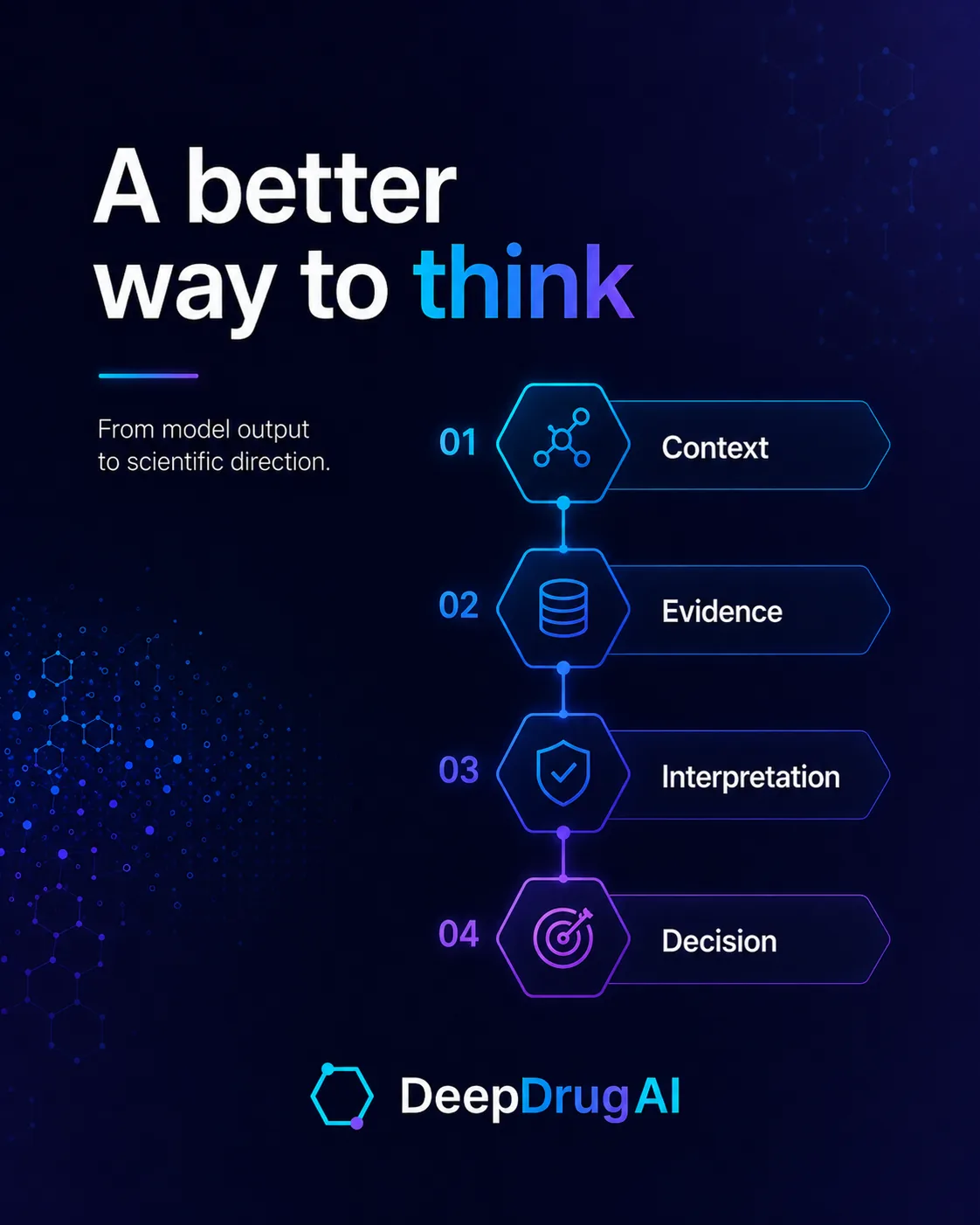
A better way to think
From model output to scientific direction.
The problem with tool-first thinking
A tool-first workflow usually starts with available software and ends with whichever output looks most impressive. This is why many projects become a chain of docking, scoring, short MD, RMSD, and a conclusion that overstates the evidence. The problem is not the tools themselves. The problem is using them without a decision framework.
A better sequence
A better scientific sequence is context, evidence, interpretation, and decision. Context defines the biological and structural situation. Evidence brings together docking poses, interaction fingerprints, model confidence, molecular dynamics behavior, and known literature. Interpretation asks what the evidence means and what could be wrong. Decision chooses the next justified step.
Why this improves research
This structure reduces overclaiming. It helps researchers explain why a pose is plausible, why a simulation adds value, why a score is only a signal, and why a conclusion is limited. It also makes computational work easier to communicate to supervisors, reviewers, collaborators, or industry teams.
Practical takeaway
Do not present isolated outputs. Present a chain: biological context, computational evidence, interpretation limits, and decision. That is the difference between running software and doing computational science.
How this connects to the cohort
The DeepDrug AI Summer Founding Cohort 2026 turns these principles into a practical workflow. Participants learn how to move from structure intelligence and ligand preparation to docking, AI-assisted scoring, pose validation, MD interpretation, and final decision logic. The objective is not to run more tools blindly. The objective is to make better scientific decisions.