
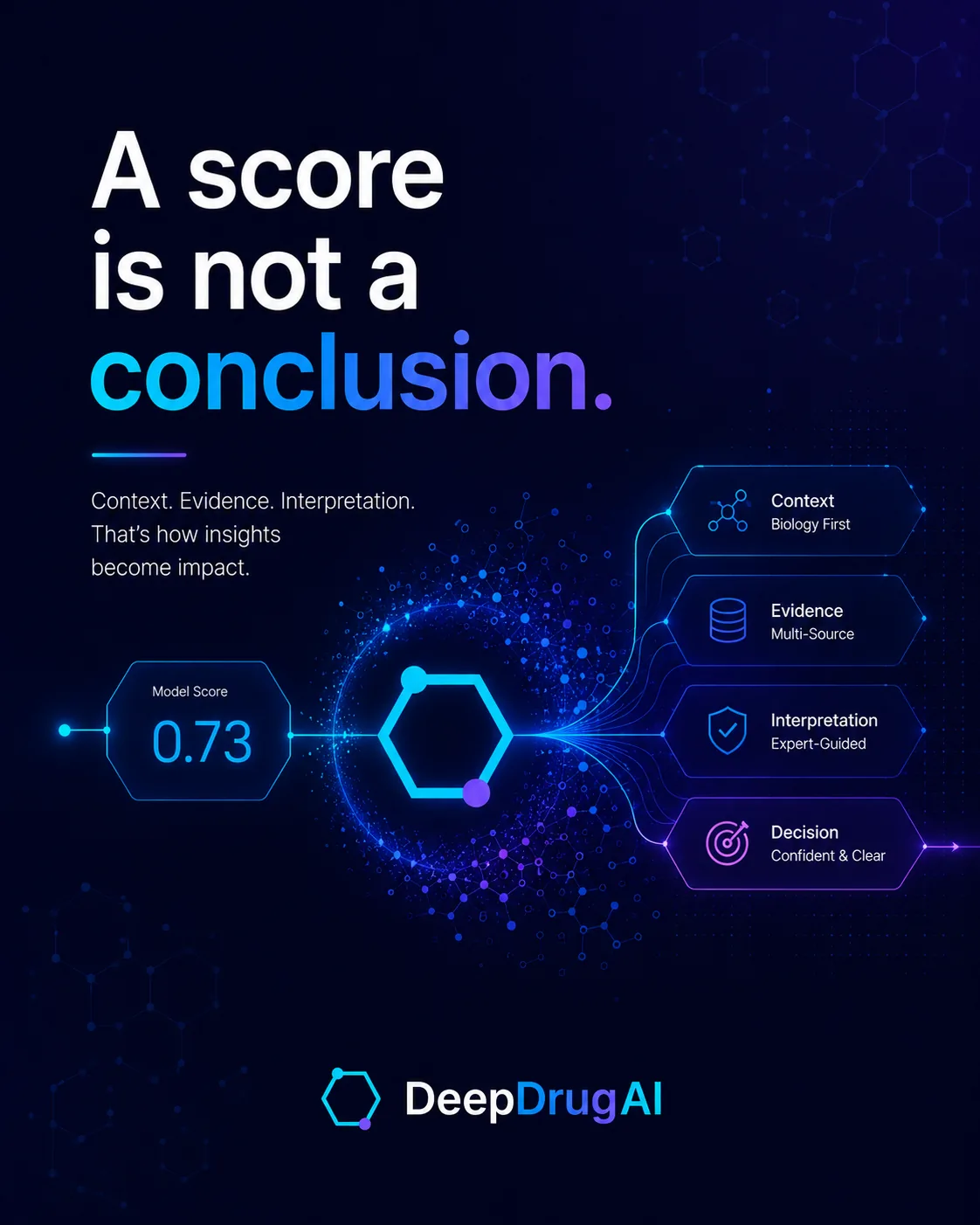
A score is not a conclusion
Context, evidence, and interpretation turn scores into useful insight.
What a score can do
Scores are useful for triage. They help rank, filter, compare, and prioritize. In docking and AI-assisted scoring, they can point attention toward candidates that may deserve closer inspection. But a score is not a measurement of truth. It is a model output that reflects assumptions, approximations, and training or scoring behavior.
Why scores mislead
A high score can come from unrealistic geometry, ligand strain, missing waters, wrong protonation, scoring bias, or a pocket that does not represent the relevant biological state. Conversely, a lower-scoring pose may be chemically more plausible if it matches known interactions or structural evidence.
How to interpret scores responsibly
Use scores as a first signal, then add layers: pose plausibility, contact quality, comparison across methods, known biology, interaction fingerprints, simulation behavior, and uncertainty. When multiple independent signals support the same story, the decision becomes stronger.
Practical takeaway
Use scores to generate hypotheses, not conclusions. A score becomes valuable only when it is interpreted within an evidence chain.
How this connects to the cohort
The DeepDrug AI Summer Founding Cohort 2026 turns these principles into a practical workflow. Participants learn how to move from structure intelligence and ligand preparation to docking, AI-assisted scoring, pose validation, MD interpretation, and final decision logic. The objective is not to run more tools blindly. The objective is to make better scientific decisions.