
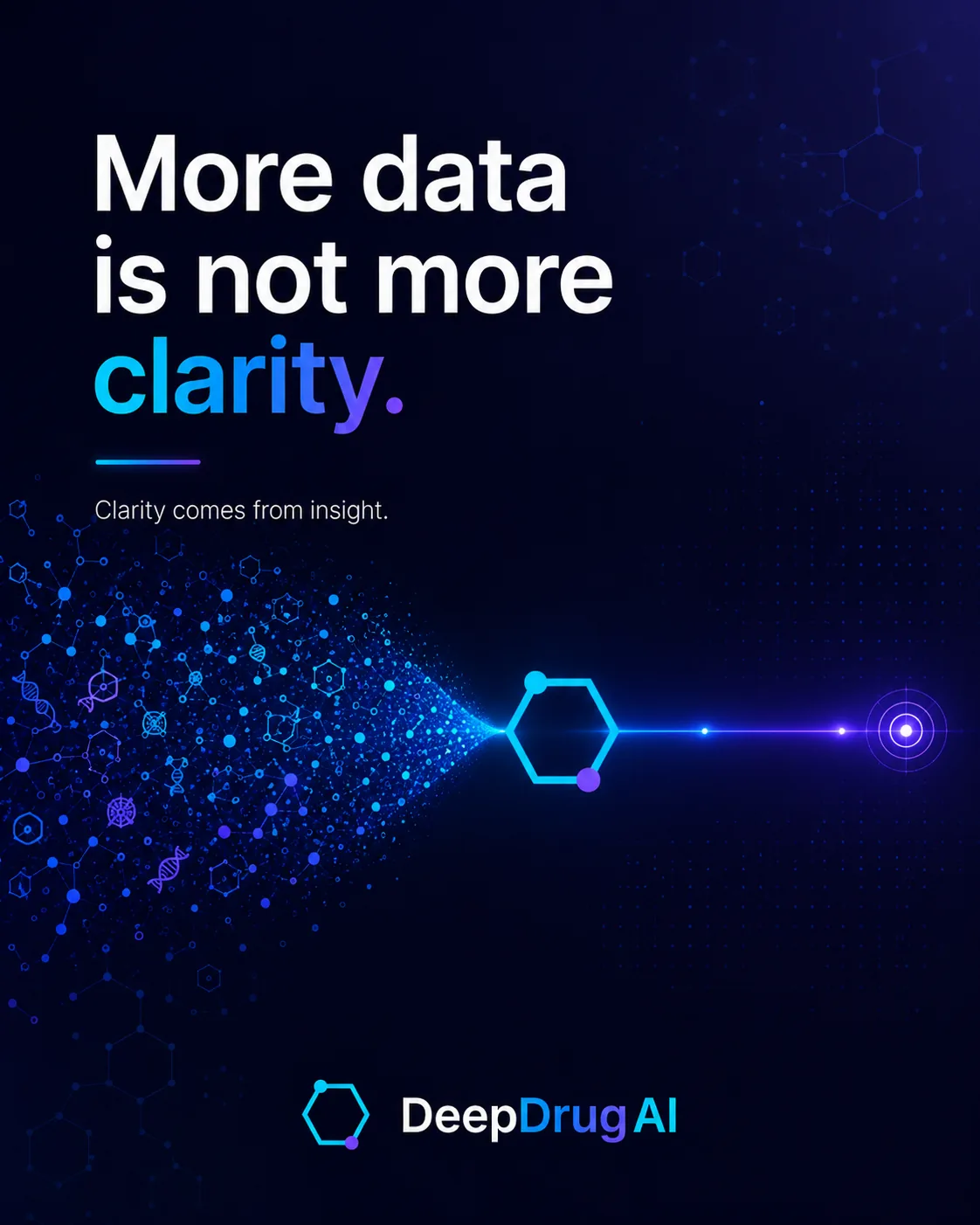
More data is not more clarity
Clarity comes from insight.
The data trap
It is easy to believe that more outputs create better science. More docked poses, more scoring functions, more MD plots, more AI predictions, and more supplementary figures can make a project look sophisticated. But if the outputs are not organized around a scientific question, they create noise rather than clarity.
What clarity requires
Clarity requires prioritization. Which result directly addresses the question? Which result checks an assumption? Which result contradicts the story? Which result is redundant? Which result is too uncertain to use? A strong workflow removes unnecessary noise and highlights the evidence that matters.
How DeepDrug AI frames it
DeepDrug AI emphasizes decision-oriented analysis. The aim is not to collect every possible output. The aim is to understand what each output contributes to the evidence chain. When data does not change interpretation or decision, it may be decoration, not insight.
Practical takeaway
Do not ask "how many analyses can I run?" Ask "which analyses improve the decision?" More data becomes clarity only when it is structured, interpreted, and connected to a question.
How this connects to the cohort
The DeepDrug AI Summer Founding Cohort 2026 turns these principles into a practical workflow. Participants learn how to move from structure intelligence and ligand preparation to docking, AI-assisted scoring, pose validation, MD interpretation, and final decision logic. The objective is not to run more tools blindly. The objective is to make better scientific decisions.