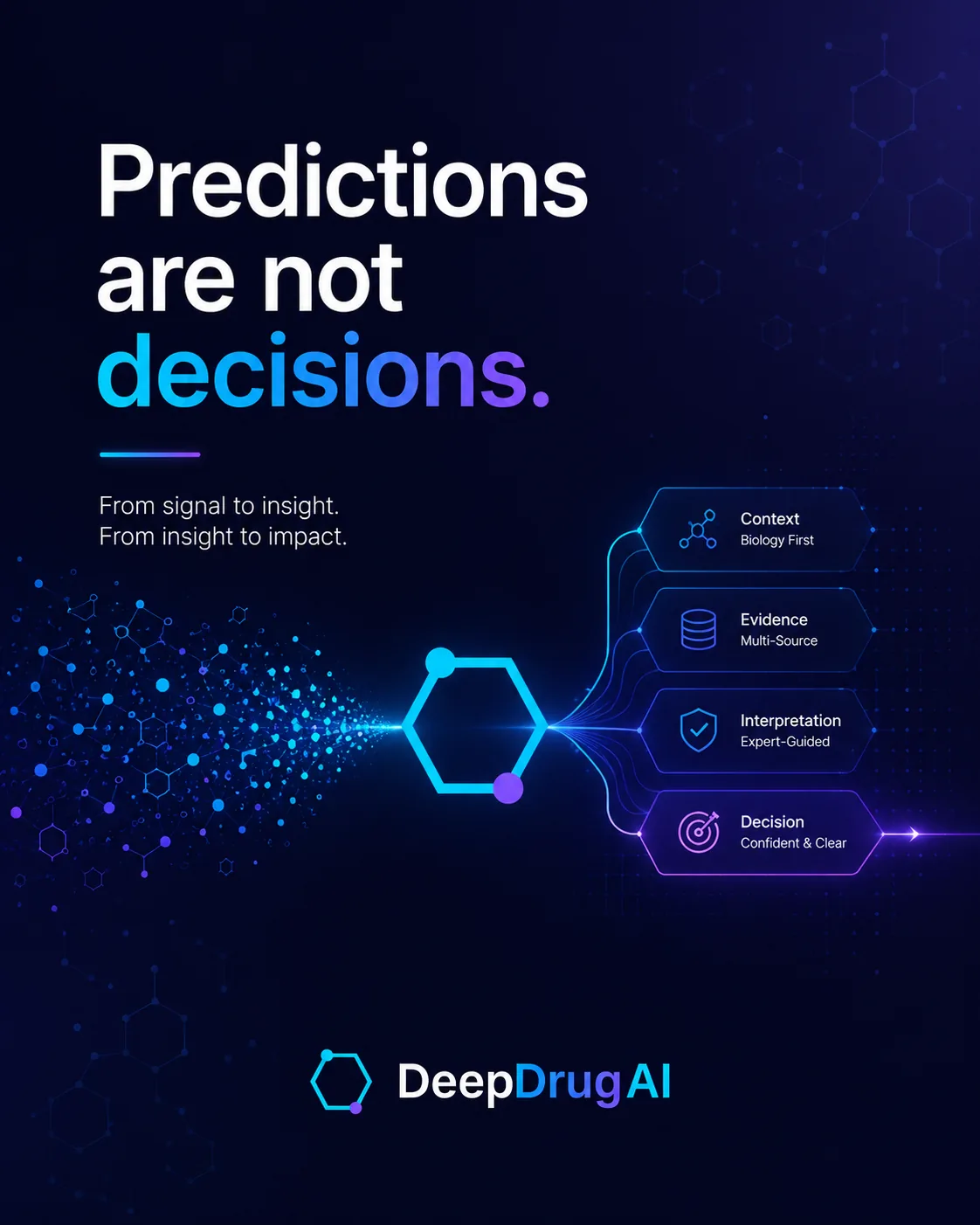
Predictions are not decisions
From signal to insight. From insight to impact.
The difference
A prediction is an output. A decision is a commitment to act based on evidence. In drug discovery, this difference matters because every decision consumes time, budget, attention, and experimental capacity. A predicted binder is not automatically worth synthesis, testing, or publication.
The missing middle
Between prediction and decision there must be a middle layer: context, evidence, and interpretation. Context asks whether the biological system is represented correctly. Evidence asks whether multiple signals support the same hypothesis. Interpretation asks what the prediction means, what could be wrong, and how confident we should be.
Why this matters for AI-assisted workflows
AI models are powerful hypothesis generators, but they do not remove the need for scientific judgment. In fact, the faster the model, the more important the decision framework becomes. Otherwise, a large number of plausible-looking predictions can create a false sense of progress.
Practical takeaway
Do not let a prediction make the decision for you. Use prediction to focus attention, validation to test plausibility, interpretation to understand meaning, and decision logic to choose the next step.
How this connects to the cohort
The DeepDrug AI Summer Founding Cohort 2026 turns these principles into a practical workflow. Participants learn how to move from structure intelligence and ligand preparation to docking, AI-assisted scoring, pose validation, MD interpretation, and final decision logic. The objective is not to run more tools blindly. The objective is to make better scientific decisions.