
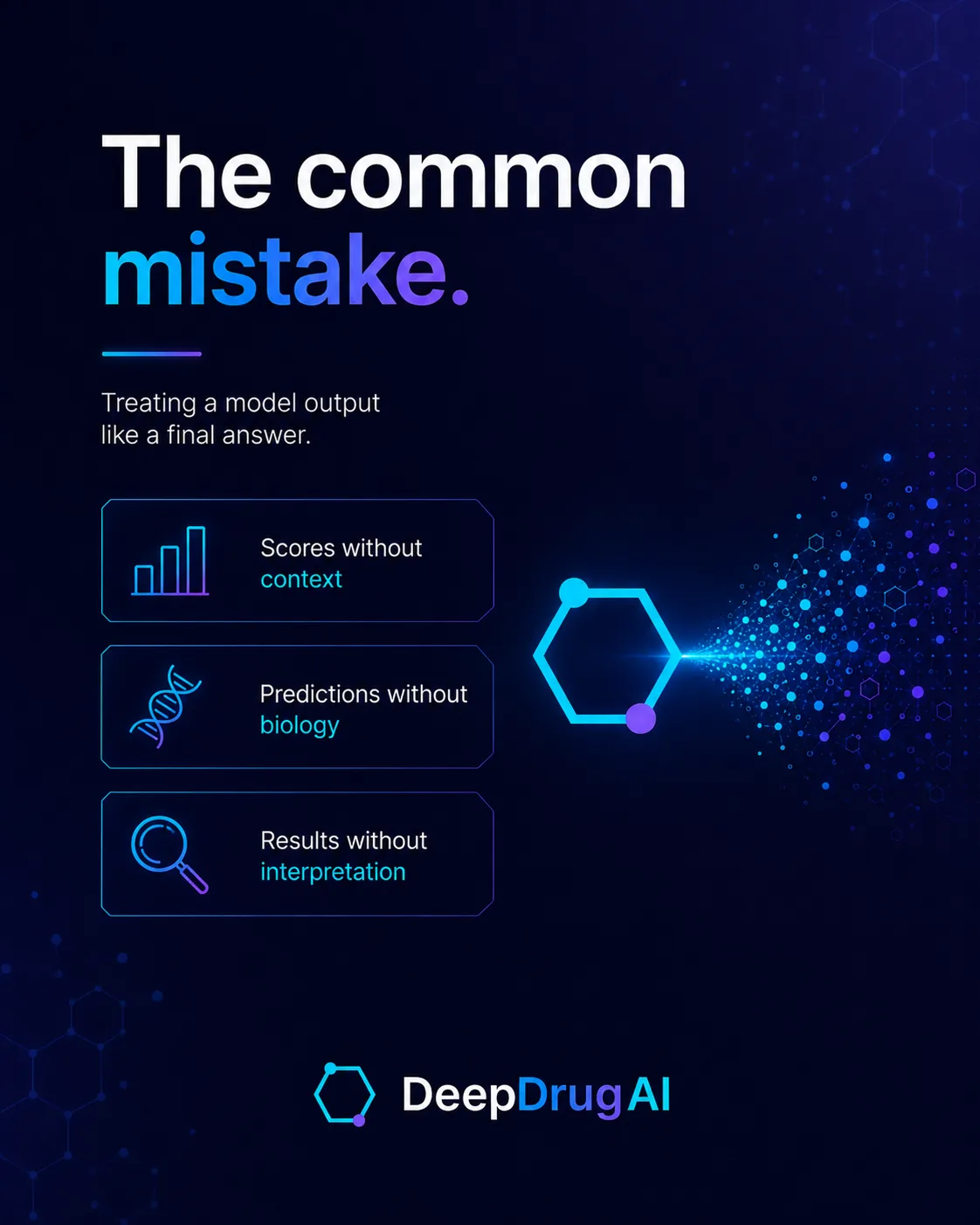
The common mistake
Treating a model output like a final answer.
The mistake
The most common mistake in computational drug discovery is treating model output as the endpoint. A docking score becomes a binding claim. A predicted complex becomes a validated mechanism. A short MD run becomes proof of stability. This is not science; it is protocol-driven storytelling.
What outputs really are
Computational outputs are signals. Some are useful, some are misleading, and many are conditional on assumptions that are easy to forget. A score is a ranking heuristic. A pose is a structural hypothesis. A simulation is a dynamic experiment with finite sampling. An AI prediction is a learned estimate, not a biological fact.
What should happen instead
A good workflow forces interpretation. Why is this structure relevant? Why should this ligand state be used? Why is this pose plausible? What interactions persist? What alternative explanation exists? What claim is justified, and what claim is too strong?
Practical takeaway
Never move directly from output to conclusion. Insert an interpretation layer: context, plausibility, validation, uncertainty, and decision. That is where scientific quality is built.
How this connects to the cohort
The DeepDrug AI Summer Founding Cohort 2026 turns these principles into a practical workflow. Participants learn how to move from structure intelligence and ligand preparation to docking, AI-assisted scoring, pose validation, MD interpretation, and final decision logic. The objective is not to run more tools blindly. The objective is to make better scientific decisions.