
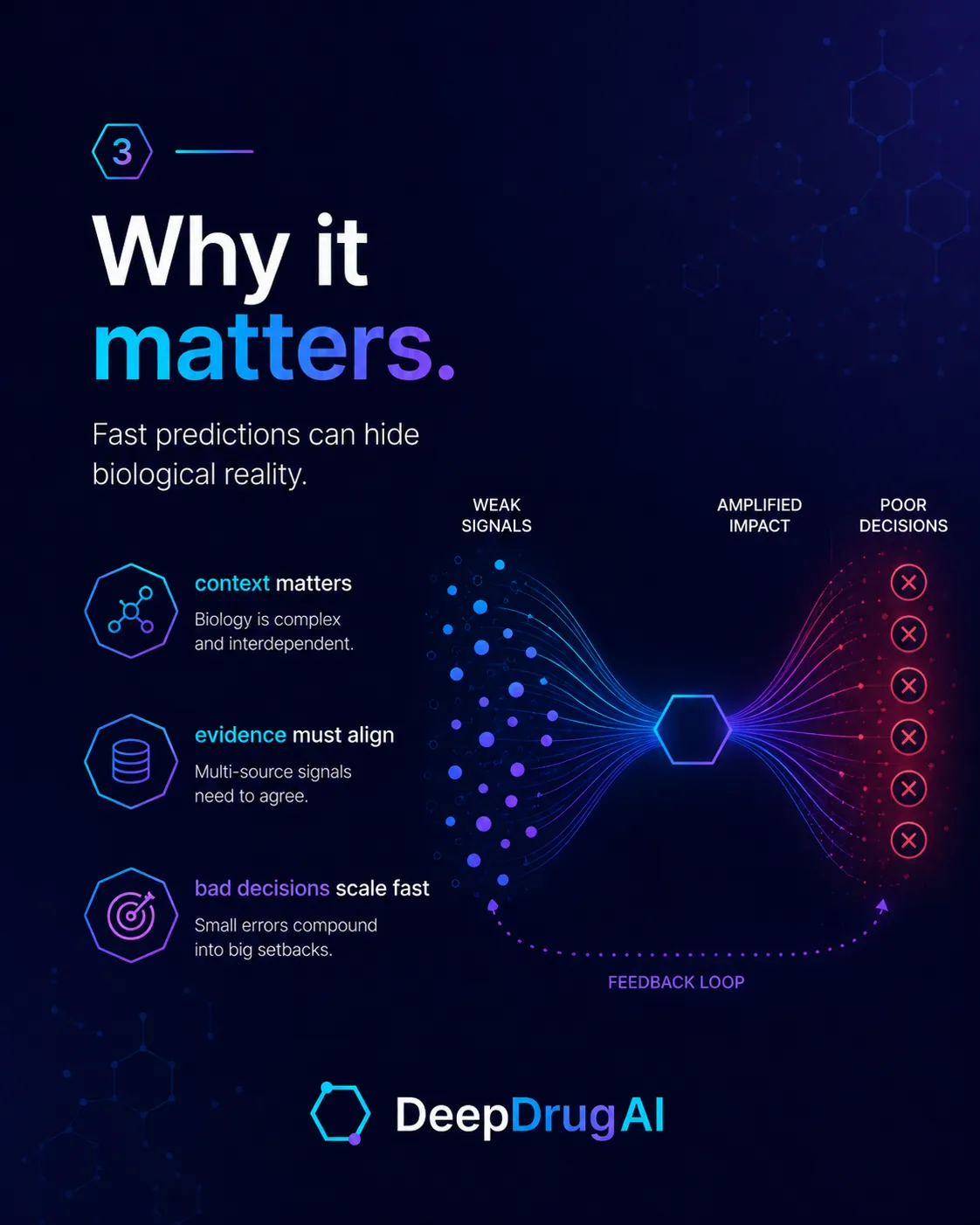
Why it matters
Fast predictions can hide biological reality.
Fast does not mean reliable
Modern models can produce predictions quickly, but speed can create false confidence. A fast pose, a fast score, or a fast affinity estimate still depends on structure quality, ligand state, protein state, training data, assumptions, and validation. Without context, speed simply helps us make mistakes faster.
Where errors enter
Errors can start small: a wrong protonation state, a missing cofactor, an ignored water molecule, a flexible loop modeled with false certainty, or a docking box that does not match the biological site. When these weak signals enter downstream analysis, they can be amplified by scoring, ranking, simulation, and interpretation.
Why validation is not optional
Validation checks whether the molecular story is physically and biologically plausible. Are there clashes? Is the ligand strained? Are key interactions reasonable? Does the pose agree with known chemistry or mutagenesis? Does MD preserve meaningful contacts or simply produce decorative trajectories? These questions protect the workflow from false conclusions.
Practical takeaway
Treat every prediction as a hypothesis. Then ask what evidence would weaken it, what evidence would support it, and what decision it can realistically justify. That is why validation and interpretation matter.
How this connects to the cohort
The DeepDrug AI Summer Founding Cohort 2026 turns these principles into a practical workflow. Participants learn how to move from structure intelligence and ligand preparation to docking, AI-assisted scoring, pose validation, MD interpretation, and final decision logic. The objective is not to run more tools blindly. The objective is to make better scientific decisions.