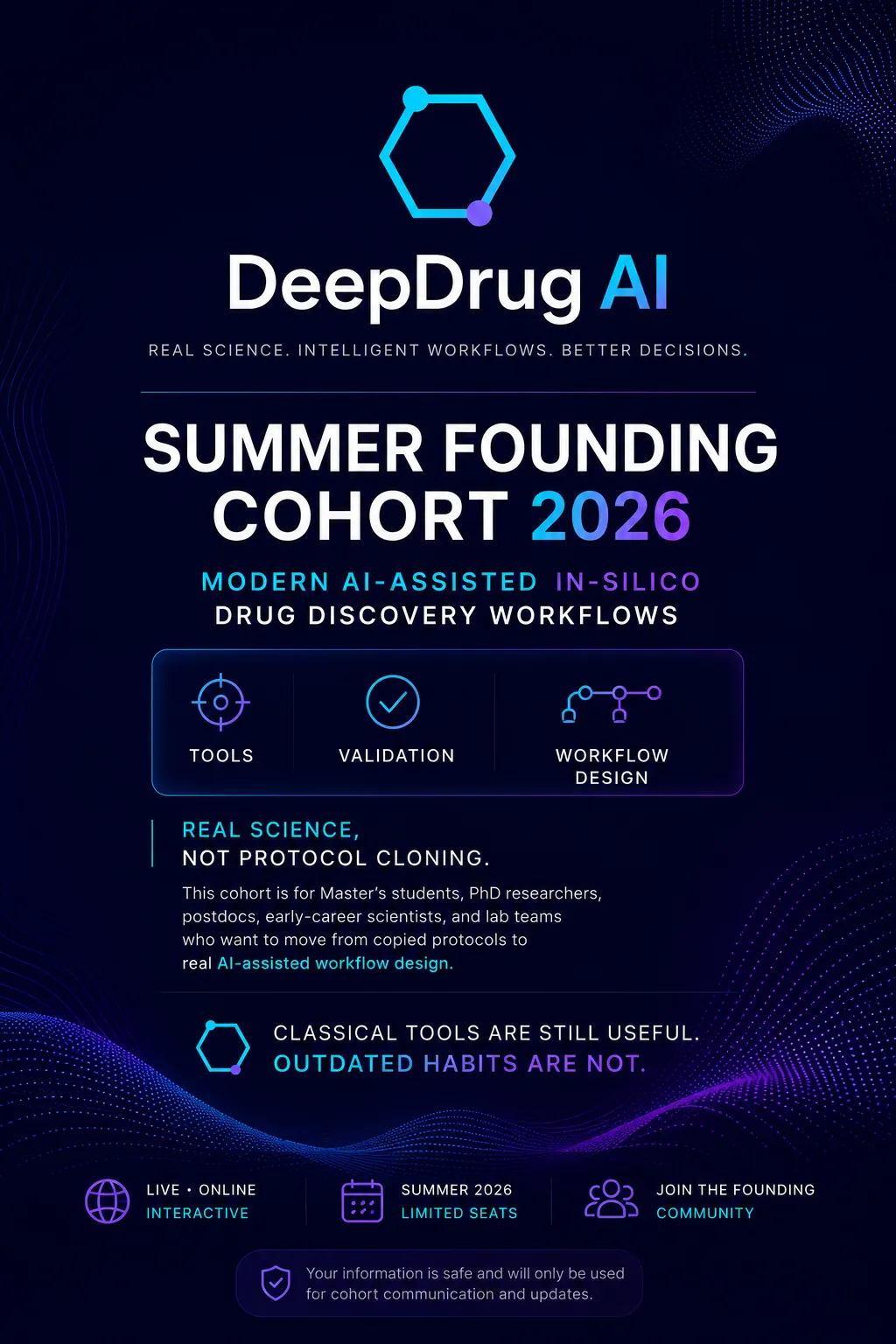
Modern AI-Assisted In-Silico Drug Discovery Workflows
Beginner-accessible, but not basic. This cohort starts with the workflow foundations and progressively moves toward modern validation, MD interpretation, affinity thinking, and decision-making.
Real science, not protocol cloning. Classical tools are still useful. Outdated habits are not.
This is not a workshop where participants simply copy a docking command, run a short MD trajectory, generate RMSD/RMSF plots, and call the result a conclusion. The goal is to teach a stronger way to think about computational drug discovery: define the scientific question, understand the structure and biological context, choose tools deliberately, validate outputs, interpret uncertainty, and decide what claim is justified.
Participants will learn how classical tools and modern AI-assisted tools can work together. Docking, scoring, molecular dynamics, structure prediction, and affinity estimation are treated as parts of an evidence chain, not as independent magic answers.
Session 0 — Optional Beginner Primer
What molecular docking actually predicts and what it does not predict.
What molecular dynamics adds, and why simulation is not automatically proof.
What docking scores mean, why they can mislead, and how beginners overinterpret them.
The basic protein-ligand workflow map from target selection to interpretation.
Common beginner mistakes: wrong protein state, incorrect ligand form, missing cofactors, blind water removal, and unvalidated poses.
Affinity thinking: MM/PBSA carefully, AI affinity signals, OpenFE concepts, uncertainty, and decision logic.
Bonus Advanced Preview
The cohort also previews the scientific challenges that appear in advanced systems: membrane proteins, GPCRs, cofactors, ions, water networks, and complex biological environments. These topics show why biology resists shortcuts and why workflow design matters.
Tools & Materials Delivered
A practical participant kit, not just lectures.
Participants receive the practical workflow materials used during the cohort.
Delivered materials
Setup guides
Example datasets
Reproducible notebooks
Validation checklists
Pose-review templates
MD interpretation templates
Decision-report templates
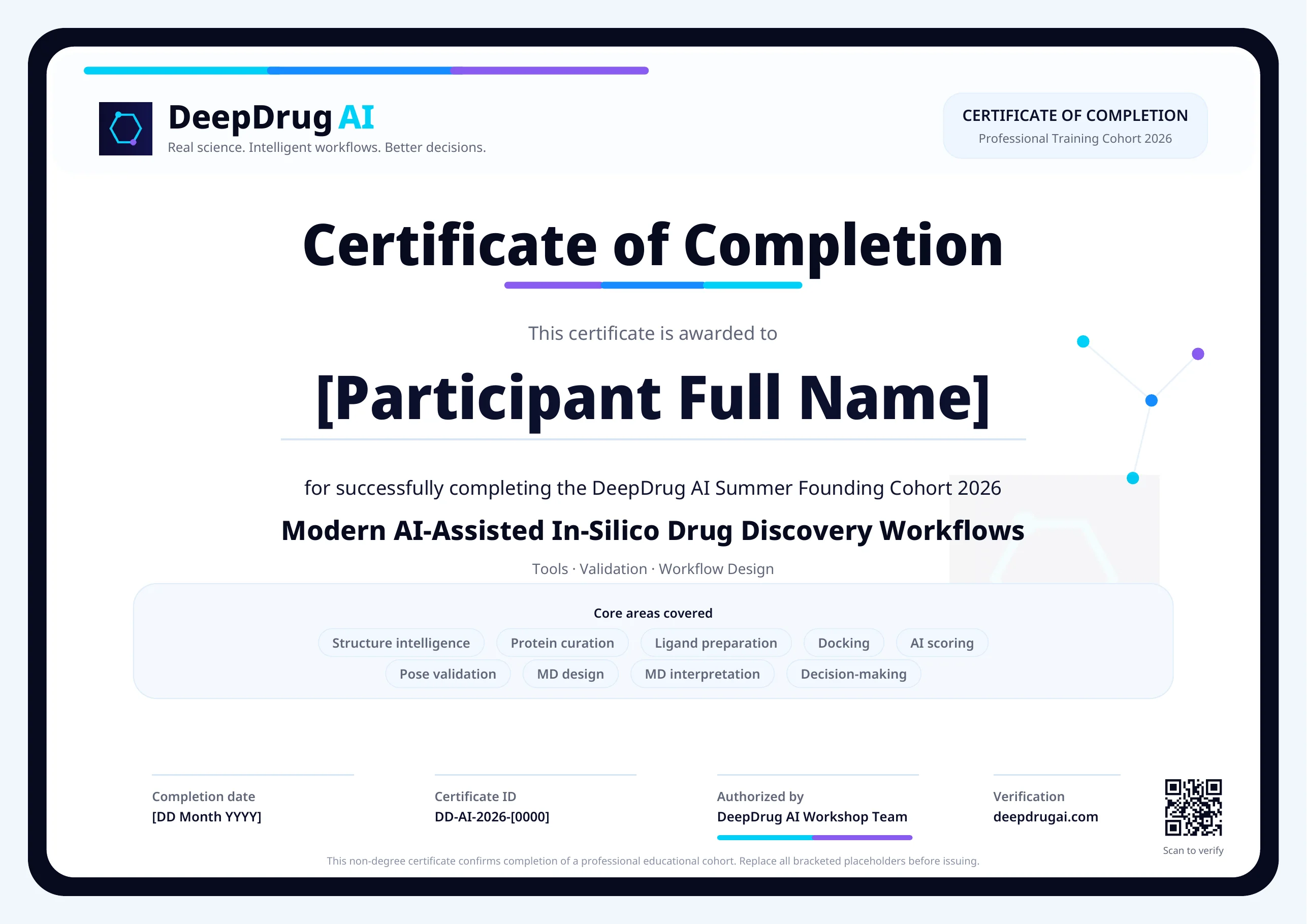
Certificate of completion
Every participant who completes the cohort receives a verifiable DeepDrug AI Certificate of Completion.
Who should join?
This cohort is designed for Master’s students, PhD researchers, postdocs, early-career scientists, academic labs, and professional teams working around pharmacy, biotechnology, medicinal chemistry, bioinformatics, computational biology, and drug discovery.
You do not need to be advanced. You do need to be willing to think critically about tools, assumptions, validation, and conclusions.